


How does PVD and RD look in USG and how to differentiate
How PVD looks in USG:
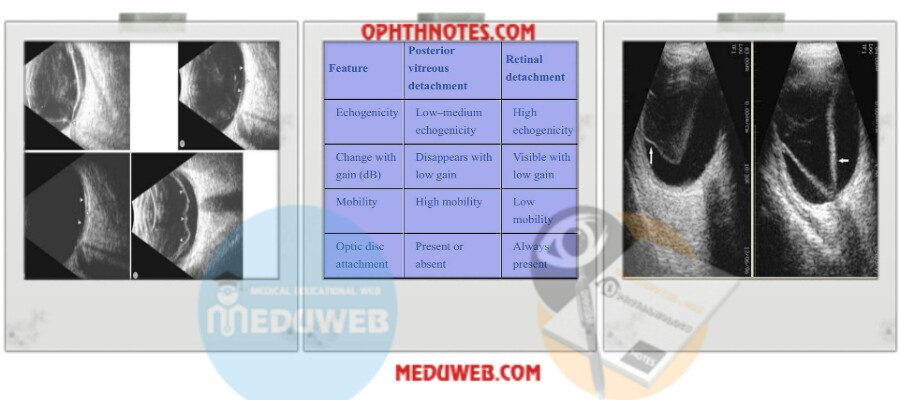
✍️ It can be focal or extensive and may be completely separated or remain attached to disk or at other sites ( NVE/tears/impact sites in trauma/arcades)
✍️ B-scan—smooth, thick membranous with fluid undulating after movements.
✍️ A Scan low(normal eye) to high (as in dense hemorrhage) reflectivity with marked horizontal and vertical spike after movements.
How does retinal detachment (RD) look in USG?
✍️ B-scan : Bright, continuous folded membrane with more tethered restricted after movement
✍️ Total RD is attached usually at disk and ora.
✍️ A-scan 100% tall single spike at tissue sensitivity
✍️ Less than 100% spike is seen if retina is atrophic, severely folded or disrupted.
✍️ Very mobile RD is seen if it is bullous.
✍️ Hemorrhagic RD produces echoes in the subretinal space.
✍️ Configuration of RD vary from
• Very shallow
• Flat and smooth membrane
• A bullous folded and funnel shaped membrane.
• The funnel shape may be open or closed and may be concave, triangular or T-shaped.
✍️ Longstanding RD may develop cyst with cholesterol crystals that produce bright echoes and RD may echolucent.
PVD and RD look in USG PowerPoint presentation:
USG B SCAN Dr.Gyanendra LamichhanaeVitreo retinal Fellow, Gunma University ,JAPAN Lumbini Eye Institute, Bhairahawa
- What is ultrasound• sound pressure with a frequency greater than the upper limit of human hearing.• Although this limit varies from person to person, it is approximately 20 kilohertz (20,000 hertz) in healthy, young adults
- • B-scan ultrasonography is an important noninvasive technique for the clinical assessment of various ocular and orbital diseases
- HISTORY• 1793: Lazzaro Spallanzani (Italy) discovered that bats orient themselves with the help of sound whistles while flying in darkness. This was the basis of modern ultrasound application Bats use ultrasounds to navigate in the darkness
- History contd…….• World war II: a device based on piezoelectric effect developed by Paul Langevin (France) ,able of emitting & receiving ultrasound under water used as sonar.• 1956: first documented use of ocular USG, Mundt and Hughes used A scan technique to detect intraocular tumour.• 1972: First use of hand held B scan by Bronston & workers ,which was applied directly to the closed lid without a water bath
- • Principles of ultrasound:• By definition, an ultrasound wave has a frequency greater than 20 kHz (20,000 oscillations/ second)• As the frequency of USG increases, the wavelength decreases and wavelength of an ultrasound determines its depth of tissue penetration and resolution Wavelength α Depth of penetration of the ultrasound• So, Larger is the frequency of US = shorter is its wavelength = shallower is its penetration = better is the resolution of resultant echo graph.

